
Bird of the Month: Swainson’s Thrush
The Swainson’s Thrush (Catharus ustulatus) is one of the quiet wonders of fall migration. Unlike the bold flashes of color we often associate with warblers or tanagers, this species is subtle, earthy, and easy to miss unless you are listening closely. Yet for many birders, the first encounter with a Swainson’s Thrush is unforgettable, not because of how it looks, but because of how it sounds.
On late summer and early fall nights across Colorado, Swainson’s Thrushes are passing overhead in the darkness, moving south from their breeding grounds in Canada and Alaska toward wintering areas deep in Central and South America. Most people never see them in flight. Instead, they may only notice a soft, spiraling, flute-like song drifting through the trees during a brief stopover at dawn or dusk.
This species belongs to the genus Catharus, a group known for some of the most hauntingly beautiful songbirds in North America. Within that group, the Swainson’s Thrush stands out as one of the most widespread and important long-distance migrants. Its journey spans thousands of miles, linking boreal forests to tropical rainforests in a single annual cycle.
The scientific name Catharus ustulatus reflects its placement among thrushes, while “ustulatus” refers to its slightly warm or burnt-toned coloration in some populations. Two major forms exist, coastal and inland, which differ slightly in coloration and migration routes, a fascinating example of how geography shapes evolution.
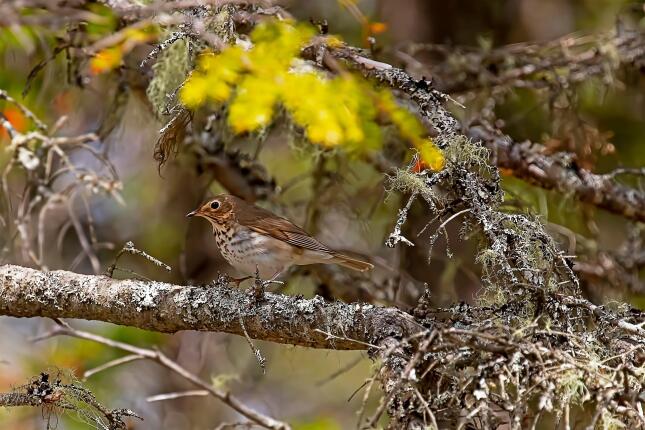
Despite its importance, the Swainson’s Thrush is often overlooked because of its modest appearance. Olive-brown upperparts, a buffy chest, and subtle spotting on the throat make it blend easily into dense vegetation. But its understated plumage hides a bird capable of one of the most remarkable migrations in the Western Hemisphere.
Before continuing into its life history, it is worth pausing on a conversation happening in ornithology today. The American Ornithological Society is actively reviewing and changing bird names that honor people. While Swainson’s Thrush is named after the English naturalist William Swainson, many birders and conservationists are now reflecting on what these names mean and how they shape our connection to wildlife.
If you could help rename this bird, what name would you choose? We’d love to hear your suggestions in the comments or when you visit us in the store!
Quick Facts
Length: 6.5 to 7.5 inches
Wingspan: 11 to 12 inches
Weight: 0.8 to 1.6 ounces
Lifespan: Typically 3 to 5 years, though some live longer
Habitat: Boreal forests, mixed woodlands, dense understory, riparian thickets
Range: Breeds across Canada and Alaska, migrates through most of the United States, winters in Central and South America
Diet: Insects, spiders, berries, small fruits
Conservation Status: Least Concern, though some populations show regional declines
Identification
Swainson’s Thrushes are medium-small thrushes with a warm, muted appearance designed for blending into shaded forest environments.
They are generally olive-brown on the back, with a lighter buff or cream-colored chest. The throat often shows subtle spotting that fades into the upper breast. Their eyes are large and dark, giving them a gentle, alert expression.
One of the best field marks, especially for experienced birders, is the faint buffy “spectacles” around the eye area in some individuals, though this can be subtle and variable.
Compared to the more familiar Hermit Thrush, Swainson’s Thrush tends to look slightly more uniform in coloration, with less contrast between tail and body.
However, the most reliable way to identify this species is often by sound rather than sight.
Habitat and Range
During the breeding season, Swainson’s Thrushes are closely associated with dense, moist forests. In northern regions, this often includes boreal coniferous forests dominated by spruce, fir, and mixed deciduous trees.
They prefer areas with thick understory vegetation, where they can forage and nest with protection from predators.
During migration, however, their habitat use becomes much more flexible. In Colorado, they are most often encountered in wooded corridors, parks, riparian areas, and suburban neighborhoods with dense shrubs and mature trees.
They are especially likely to pass through during nighttime migration, resting briefly in sheltered areas during the day before continuing their journey south.
In winter, they inhabit humid tropical forests, often in lowland and foothill regions of Central and South America, where they join mixed-species flocks in dense vegetation.
Food Preferences and Feeding Behavior
Swainson’s Thrushes have a varied diet that shifts with the seasons.
During the breeding season, they rely heavily on insects and other invertebrates. Beetles, ants, caterpillars, flies, and spiders make up a large portion of their diet. They forage primarily on the ground or in low vegetation, using a slow, deliberate hopping motion as they search through leaf litter.
During migration and in winter, their diet expands to include a wide variety of fruits and berries. This dietary flexibility is essential for fueling their long-distance journeys.
They play an important ecological role as seed dispersers in tropical forests. As they consume fruit, they help distribute seeds across wide areas, contributing to forest regeneration and plant diversity.
Swainson’s Thrushes are generally shy and unobtrusive while feeding. They often remain hidden in dense cover, making them easier to hear than to see.
Courtship and Mating
Swainson’s Thrushes establish breeding territories soon after arriving on their northern breeding grounds in late spring. Males are the primary singers, using their ethereal, flute-like songs to establish territory and attract mates.
Unlike many brightly colored songbirds, Swainson’s Thrush relies almost entirely on vocal performance rather than visual display. Males sing from concealed perches within dense forest understory, often remaining difficult to spot even when actively vocalizing.
Once a female selects a mate, the pair forms a temporary bond for the breeding season. Like most thrushes, they are socially monogamous during nesting, but pairs typically do not remain together outside of the breeding period.
Courtship is subtle and involves song, proximity, and occasional food sharing. Males may follow females through the territory while continuing to sing, reinforcing the bond before nesting begins.
Swainson’s Thrushes build nests in dense vegetation, usually within shrubs or low trees, often 2 to 10 feet above the ground. The nests are carefully hidden, blending into the surrounding foliage.
The nest is a well-constructed open cup made from twigs, grass, moss, and bark strips. The interior is lined with softer materials such as rootlets, pine needles, and fine plant fibers. Mud is sometimes incorporated into the structure to help stabilize the base.
Females are solely responsible for nest construction, which typically takes several days to complete. The result is a surprisingly sturdy structure designed to withstand forest winds and occasional rain.
A typical clutch consists of 3 to 5 eggs, which are pale blue to greenish-blue and unmarked or lightly speckled.
Only the female incubates the eggs, which hatch after approximately 10 to 14 days. During this period, the male may remain nearby and continue defending the territory, but he does not participate in incubation.
Once the eggs hatch, both parents may help feed the young, bringing a steady supply of insects. Nestlings grow quickly on this protein-rich diet.
Swainson’s Thrush chicks are born helpless, with closed eyes and little to no feathering. They remain in the nest for roughly 10 to 14 days, during which they undergo rapid development.
Feeding frequency is high, especially during warm weather when insect activity is strong. Parents make frequent trips to and from the nest, often returning with small caterpillars and soft-bodied insects.
Young Swainson’s Thrushes typically fledge at around 10 to 14 days after hatching. At this stage, they leave the nest but remain dependent on adults for food and protection for another 2 to 3 weeks.
During this post-fledging period, juveniles gradually learn to forage independently. They remain hidden in dense vegetation, making them difficult to observe.
By the time they become fully independent, many young birds are already beginning to prepare for migration. This means that within a matter of weeks, they transition from nestlings in northern forests to long-distance migrants traveling thousands of miles south.
Tips for Spotting Swainson’s Thrush
In Colorado, Swainson’s Thrush is most often encountered during migration rather than breeding. The best times to look for them are late August through early October.
They are easiest to detect at dawn and dusk, especially in wooded areas, riparian corridors, and dense shrub habitats. However, even when present, they can be extremely difficult to see due to their secretive nature. They are a popular visitor around the banding station at Chico Basin Ranch!
The most reliable way to detect them is by sound. Their song is a soft, upward-spiraling series of flute-like notes that seems to echo through shaded forests. Many birders describe it as one of the most beautiful songs of migration season.
Listen carefully in quiet areas during early morning hours, especially after cool nights that encourage migratory stopovers.
Vocalizations and Calls
The Swainson’s Thrush song is often described as ethereal or otherworldly. It consists of a series of rising, flute-like phrases that spiral upward in pitch.
Calls include soft “whit” or “quip” notes, often given when birds are flushed or moving through dense vegetation.
During migration, nocturnal flight calls may be given overhead at night, though these are rarely heard without specialized monitoring.
Conservation Concerns
Swainson’s Thrush is currently considered a species of Least Concern, but like many long-distance migrants, it faces a complex set of challenges across its full annual cycle.
Habitat loss on both breeding and wintering grounds is a primary concern. Boreal forests in North America and tropical forests in Central and South America are both subject to logging, fragmentation, and development pressures.
Because this species depends on multiple ecosystems across continents, conservation requires international cooperation.
Light pollution is another growing concern. Migrating birds often travel at night and can become disoriented by artificial lighting, increasing the risk of collisions with buildings.
Despite these pressures, Swainson’s Thrush remains relatively widespread, thanks in part to its adaptability and broad range of habitats.
Role in the Ecosystem
Swainson’s Thrush plays an important dual role in ecosystems across the Western Hemisphere.
In northern forests, it helps regulate insect populations by consuming large numbers of caterpillars and other invertebrates during the breeding season.
In tropical forests, it becomes an important seed disperser. By consuming fruits and excreting seeds in new locations, it helps maintain plant diversity and forest regeneration.
This seasonal shift in ecological role makes the Swainson’s Thrush a true “connective species,” linking ecosystems across continents.
Bird Feeding Connections
Swainson’s Thrush is not a typical feeder bird and rarely visits backyard feeders.
However, it may be attracted to naturalized yards that provide dense shrubs, native plantings, and berry-producing trees and bushes.
Landscapes that support native fruiting plants such as serviceberry, elderberry, and dogwood can provide important stopover resources during migration.
The best way to support this species is not through feeders, but through habitat. Dense cover, reduced pesticide use, and native plantings all help create safe migration stopover sites.
The Swainson’s Thrush is one of the great unseen travelers of the bird world. It moves through Colorado each year almost like a whisper, more often heard than seen, connecting boreal forests to tropical jungles in a single continuous journey.
Its presence reminds us that migration is not just a seasonal event, but a global cycle that depends on healthy ecosystems across continents.
For many birders, the Swainson’s Thrush is a bird you learn to appreciate not by checking it off a list, but by pausing to listen when the forest grows quiet.
And in those quiet moments, its song becomes one of the most memorable sounds of the changing season.