
Bird of the Month: Townsend's Solitaire
As autumn gives way to winter and many of Colorado's songbirds have already begun their journey south, the mountains and foothills can seem surprisingly quiet. Yet if you pause along a rocky hillside dotted with juniper trees, you may hear a clear, flute-like song drifting through the crisp November air. The singer is the Townsend's Solitaire (Myadestes townsendi), one of Colorado's most elegant and underrated winter residents.
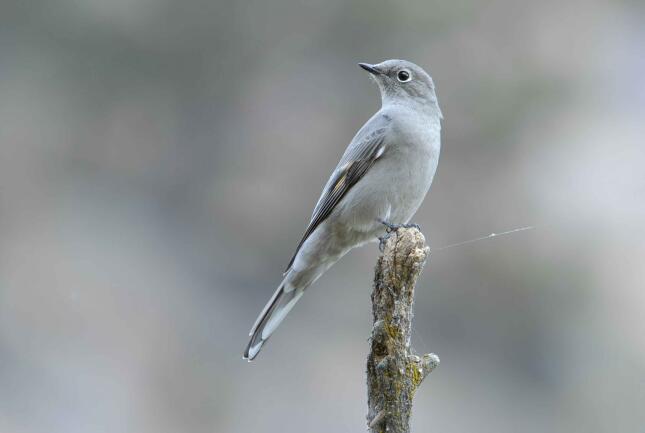
At first glance, the Townsend's Solitaire appears almost plain. Cloaked in soft shades of gray with subtle white wing markings and a delicate white eye ring, it lacks the brilliant colors that often capture our attention. But spend a little time watching one, and its beauty quickly becomes apparent. Its graceful posture, watchful nature, and hauntingly beautiful song make it one of the most rewarding birds to observe during the colder months.
Unlike many members of the thrush family, which migrate long distances to escape winter, the Townsend's Solitaire often chooses to remain in Colorado year-round or moves only short distances from higher elevations into foothills and valleys. It accomplishes this remarkable feat through an unusual dietary specialization. While insects become scarce and snow blankets the landscape, the Solitaire turns to one of nature's most dependable winter foods: juniper berries.
In fact, few North American birds are as closely associated with a single food source. Throughout autumn, winter, and even early spring, Townsend's Solitaires establish and vigorously defend berry-laden juniper trees. These winter pantries provide enough nutrition to sustain them through some of the harshest weather Colorado has to offer.
The scientific name, Myadestes townsendi, places the bird within a small group of thrushes known as the solitaires. While they share ancestry with American Robins and bluebirds, solitaires have evolved into specialists, thriving in mountainous habitats where few other songbirds remain active throughout the winter.
The bird's common name honors the American naturalist John Kirk Townsend, who collected specimens during expeditions across western North America in the early 1800s. Today, however, the birding community is participating in an important conversation about bird names. The American Ornithological Society has begun renaming birds that honor people in an effort to create names that better reflect the birds themselves rather than historical figures.
If you could help rename this bird, what name would you choose? We'd love to hear your suggestions in the comments or when you visit us in the store!
Perhaps a name inspired by its beautiful song, its devotion to juniper berries, or its quiet mountain home would better capture the spirit of this remarkable bird?
Whether you discover a Townsend's Solitaire while hiking a snowy trail or watching the berries disappear from a juniper outside your window, you're witnessing one of Colorado's greatest winter survival stories.
Quick Facts
Family: Turdidae (Thrush Family)
Length: 8–9 inches
Wingspan: 14–15 inches
Weight: 1.2–1.5 ounces (34–45 grams)
Lifespan: Typically 5–8 years, though some individuals live longer.
Habitat: Mountain forests, pinyon-juniper woodlands, rocky foothills, open conifer forests, canyons.
Range: Western North America, including much of the Rocky Mountains. Many birds remain in Colorado throughout the year.
Diet: Insects during the breeding season, juniper berries and other fruits during fall and winter.
Conservation Status: Least Concern.
Identification
Townsend's Solitaires are slender, medium-sized songbirds with an understated elegance that rewards careful observation.
Their plumage is primarily soft gray, becoming slightly paler on the underparts. A thin white eye ring gives the bird a gentle, alert expression, while bold white edges on the folded wings create one of the best field marks, especially when perched.
The tail is relatively long and often flicked slightly as the bird scans its surroundings from an exposed perch.
Unlike many thrushes, the Townsend's Solitaire lacks heavy spotting on the breast, giving it a clean, refined appearance.
Juveniles show faint spotting before gradually acquiring the smooth gray plumage of adults.
Although its colors are subtle, its upright posture and habit of perching conspicuously atop junipers, fence posts, snags, or rocky outcrops make it surprisingly easy to recognize once you know what to look for.
Habitat and Range
Townsend's Solitaires are birds of the mountains.
During the breeding season, they favor open conifer forests, especially those containing Douglas-fir, ponderosa pine, lodgepole pine, and mixed evergreen woodlands. They often nest near rocky slopes, cliffs, or forest openings.
As winter approaches, many birds move to lower elevations where juniper berries are abundant. Across Colorado, they are especially common in pinyon-juniper woodlands, foothills, canyonlands, and open mountain valleys.
Unlike many migratory songbirds, Townsend's Solitaires are highly faithful to productive winter feeding territories. A single bird may defend one patch of juniper trees for several months, rarely allowing another Solitaire to feed there.
While Colorado offers outstanding winter habitat, the species ranges throughout much of western North America, from southern Canada to northern Mexico.
Food Preferences and Feeding Behavior
The Townsend's Solitaire has one of the most specialized winter diets of any North American songbird.
During spring and summer, it behaves much like other thrushes, feeding on beetles, ants, caterpillars, flies, spiders, and other invertebrates. It forages on the ground, among rocks, and occasionally catches insects in midair.
Everything changes as autumn arrives.
When juniper berries ripen, the Solitaire shifts almost entirely to fruit. These waxy blue berries become the foundation of its winter survival strategy.
Remarkably, Townsend's Solitaires can survive for months eating mostly juniper berries. Their digestive system is uniquely adapted to process the waxy coating and oils that make these berries difficult for many other birds to digest.
This close relationship highlights the importance of native plants. Without healthy juniper woodlands, Townsend's Solitaires would struggle to survive Colorado's long winters.
Courtship and Mating
As winter loosens its grip on the Rocky Mountains, Townsend's Solitaires begin transitioning from defending winter food supplies to establishing breeding territories. Depending on elevation and weather conditions, courtship typically begins in late March through May.
The male announces his territory with one of the most beautiful songs in North America. Perched high atop a conifer or rocky outcrop, he delivers a long, clear series of flute-like whistles that echo through mountain forests. Unlike the short songs of many backyard birds, the Solitaire's song can continue for several minutes, rising and falling in pitch with an almost ethereal quality. While song serves to attract a mate, it also warns rival males that the territory is occupied. During courtship, males may chase one another through the trees or perform graceful flights around favored perches.
Once a female selects a mate, the pair forms a seasonal bond. Although they cooperate closely while raising young, they generally do not remain together outside the breeding season.
Townsend's Solitaires prefer secluded nesting locations that offer both protection and camouflage. Unlike many songbirds that build nests in shrubs or tree branches, Solitaires often nest on or very near the ground. Favorite locations include rocky ledges, crevices, steep banks, fallen logs, exposed tree roots, or cavities sheltered beneath overhanging vegetation.
The female constructs the nest almost entirely on her own. She weaves together grasses, pine needles, bark strips, moss, rootlets, and small twigs to form a sturdy cup. The interior is lined with softer materials such as fine grasses, animal hair, feathers, and plant fibers to provide insulation for the developing eggs. The finished nest blends remarkably well with its surroundings, making it extremely difficult for both predators and birders to locate.
A typical clutch contains three to five pale bluish or greenish eggs with light speckling. The female incubates the eggs for approximately 12 to 14 days while the male remains nearby, defending the nesting territory and occasionally bringing food to his mate.
When the chicks hatch, they are blind, nearly featherless, and completely dependent on their parents.
Unlike adults that rely heavily on juniper berries during winter, growing nestlings require a protein-rich diet. Both parents spend long hours gathering caterpillars, beetles, spiders, ants, flies, and other insects to feed their rapidly developing young. Each day may require hundreds of feeding trips as the chicks grow larger and more demanding. This abundance of insects provides the nutrients needed to build muscles, feathers, and strong bones before the young birds leave the nest. Both adults share feeding responsibilities, and they work tirelessly from dawn until dusk. As the nestlings mature, they become increasingly vocal, greeting each returning parent with wide-open mouths and fluttering wings.
The nesting period is one of the few times each year when these normally solitary birds become highly cooperative.
Young Townsend's Solitaires grow quickly.
Approximately 13 to 16 days after hatching, the chicks leave the nest. At first, they are weak fliers and spend much of their time hidden among low branches, shrubs, or rocks while their parents continue bringing food.
During the following two to three weeks, juveniles gradually develop stronger flight skills while learning to forage independently.
Throughout late summer, young birds begin discovering berries alongside insects, preparing for the dietary shift that will help them survive their first winter.
By early autumn, they become fully independent and begin searching for winter territories of their own. Finding a productive stand of juniper trees may determine whether a young Solitaire successfully survives its first Colorado winter.
Tips for Attracting or Spotting Townsend's Solitaires
Although they rarely visit traditional seed feeders, Townsend's Solitaires love a good water source and often visit birdbaths.
The best places to search away from a bath include pinyon-juniper woodlands, foothill parks, mountain canyons, open conifer forests, cemeteries, golf courses, and neighborhoods with mature juniper landscaping.
Look for a solitary gray bird perched upright on the highest branch of a juniper tree or snag. They often choose elevated perches that allow them to watch over their berry supply while scanning for intruders. Patience is key. Solitaires may remain motionless for long periods before suddenly darting out to chase another bird away from their territory.
If your landscape includes native juniper, serviceberry, chokecherry, or other fruit-producing shrubs, you may be fortunate enough to host one during the winter months.
Unlike many winter birds, Townsend's Solitaires almost never visit feeders. However, they may occasionally sample mealworms, raisins, or small pieces of fruit if offered alongside natural food sources.
Vocalizations and Calls
Many ornithologists consider the Townsend's Solitaire to possess one of the most beautiful songs in North America.
Its primary song consists of a rich series of clear, flute-like whistles that seem almost too delicate for such a quiet-looking bird. Individual phrases vary in pitch and rhythm, creating an improvisational melody that may continue for several minutes.
While most birds sing most actively during spring, Townsend's Solitaires are unusual in that they sometimes sing throughout the winter, especially on calm, sunny mornings. Hearing such a beautiful song in an otherwise quiet winter landscape is one of the species' greatest gifts to birders.
Their everyday calls are much simpler. Sharp "tew" and "chuck" notes help communicate with mates or warn away rivals, while alarm calls become noticeably harsher when predators approach.
Conservation Concerns
Fortunately, Townsend's Solitaires remain relatively common across much of their range and are currently classified as a species of Least Concern.
Even so, they face several challenges.
Loss of native juniper woodlands due to development, wildfire, and land conversion can reduce the availability of critical winter food supplies. Because many Solitaires depend heavily on juniper berries for months at a time, healthy native plant communities are essential to their survival.
Climate change also has the potential to alter berry production, snowpack, and the timing of insect emergence, all of which could affect breeding success and winter survival.
Reducing pesticide use is another important conservation measure. During the nesting season, Solitaires rely heavily on insects to feed their young. Healthy insect populations mean healthier birds.
Protecting native habitats, planting berry-producing shrubs, and preserving mature juniper stands all help ensure that Townsend's Solitaires continue to brighten Colorado winters.
Role in the Ecosystem
Townsend's Solitaires play two important ecological roles throughout the year.
During spring and summer, they help regulate insect populations by consuming a wide variety of beetles, caterpillars, ants, spiders, and other invertebrates.
During fall and winter, they become important seed dispersers. Although they digest the fleshy portion of juniper berries, many seeds pass through their digestive system intact and are deposited in new locations. In this way, Solitaires help regenerate native juniper woodlands across the Rocky Mountain West.
Their seasonal shift from insect hunter to fruit specialist demonstrates the remarkable adaptability that allows them to thrive in Colorado's ever-changing environment.
The Townsend's Solitaire reminds us that beauty isn't always bold.
Its soft gray feathers may not draw immediate attention, but its remarkable winter survival strategy, breathtaking song, and close relationship with Colorado's juniper woodlands make it one of the state's most extraordinary birds. While many songbirds escape winter by flying south, the Solitaire embraces the season, relying on patience, resilience, and the bounty of native plants to carry it through snow, ice, and freezing temperatures.
The next time you spot a lone gray bird perched atop a juniper or hear a clear, flute-like melody echoing through a quiet mountain valley, pause for a moment. You're witnessing one of Colorado's greatest winter specialists, a bird whose story reminds us that conserving native habitats means protecting the intricate relationships between wildlife and the landscapes they call home.